
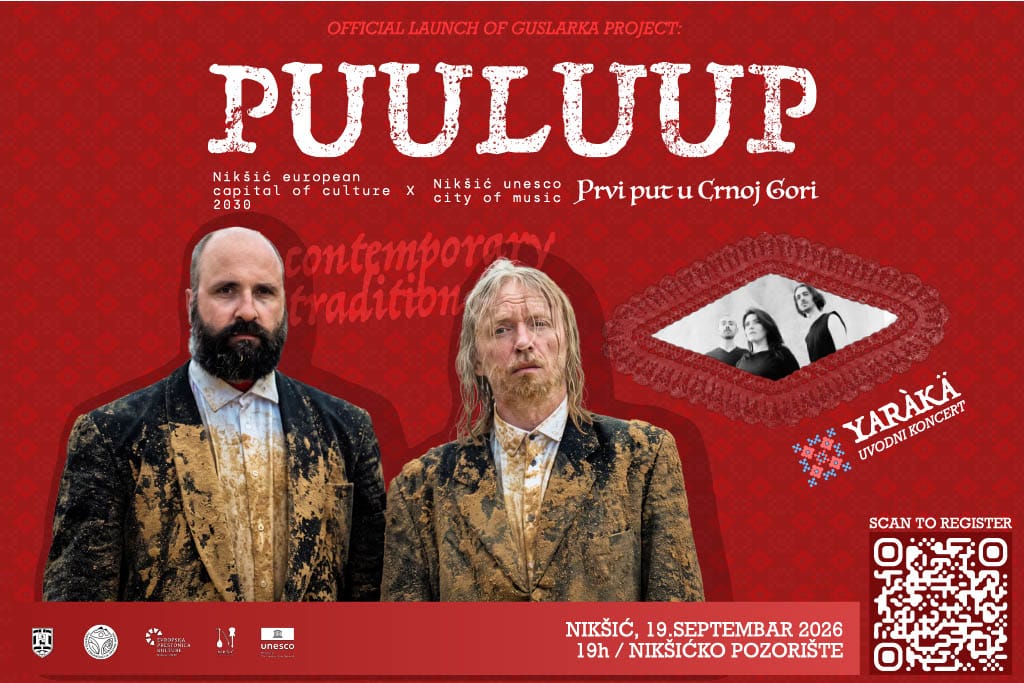
The renowned Estonian duo PUULUUP, comprising Ramo Teder and Marko Veisson, will perform in Montenegro for the first time on 19 September 2026 at the Nikšić Theatre, as part of the programme of Nikšić 2030 – European Capital of Culture and UNESCO City of Music. The duo gained wider international recognition in 2024, when they represented Estonia at the Eurovision Song Contest together with the group 5MIINUST, reaching the Grand Final.
PUULUUP is known for its distinctive fusion of traditional folk music, electronics, improvisation and humour. At the heart of their work is the talharpa, an ancient bowed string instrument whose sound they enrich with loopers, electronic effects and vocal experimentation. Drawing inspiration from Estonian and Finnish traditions, as well as West African music, they create energetic and unconventional performances that have captivated audiences across Europe.
The evening will open with the Italian ensemble Yarákä, featuring Gianni Sciambarruto, Virginia Pavone and Simone Carrino. This trio from Taranto combines the musical traditions of southern Italy with contemporary expression and influences from different cultures. Using voice, guitar, flute, saz, berimbau and various percussion instruments, Yarákä explores folk customs, rituals and the ancient connection between people and nature through music.
The performance starts at 7 PM, and admission is free with mandatory prior registration via the following link: https://shop.weeztix.com/90ce4a66-2c7d-4094-b330-6a2028c39b53/tickets.
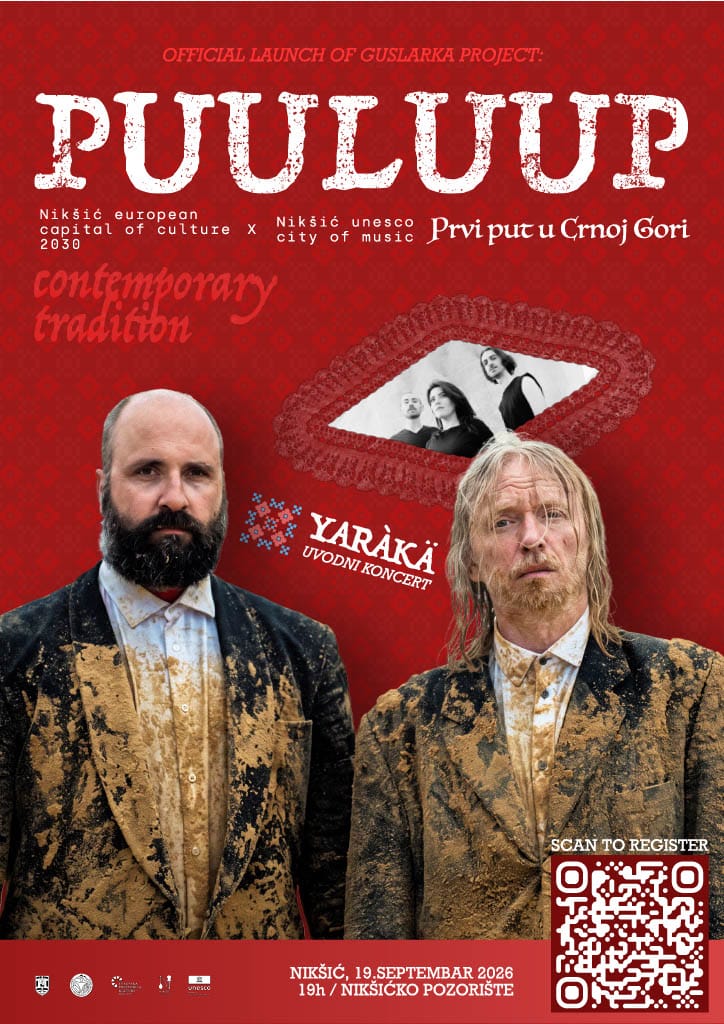
With performances by PUULUUP and Yarákä, Nikšić is positioning itself as a meeting point for traditional instruments, contemporary sound and diverse European musical cultures.
The concert serves as a preview event for the multi-year GUSLARKA PROJECT, which aims to promote traditional European instruments and explore their potential within contemporary musical expression and contemporary themes.
In the coming years, Nikšić, a city with a long-standing musical tradition, will become a meeting place for collaboration among European musicians who compose and perform music on traditional instruments. At the same time, the city will serve as a platform for musical experimentation, innovation and unexpected encounters – a place where diverse European musical traditions intersect and interact.
Following Nikšić’s designation as European Capital of Culture 2030, the Municipality of Nikšić was also designated a UNESCO City of Music. Consequently, music-related activities have been at the heart of the work of the Nikšić 2030 European Capital of Culture Office throughout 2026, with the aim of creating synergies between these two significant international recognitions that the city now holds.