
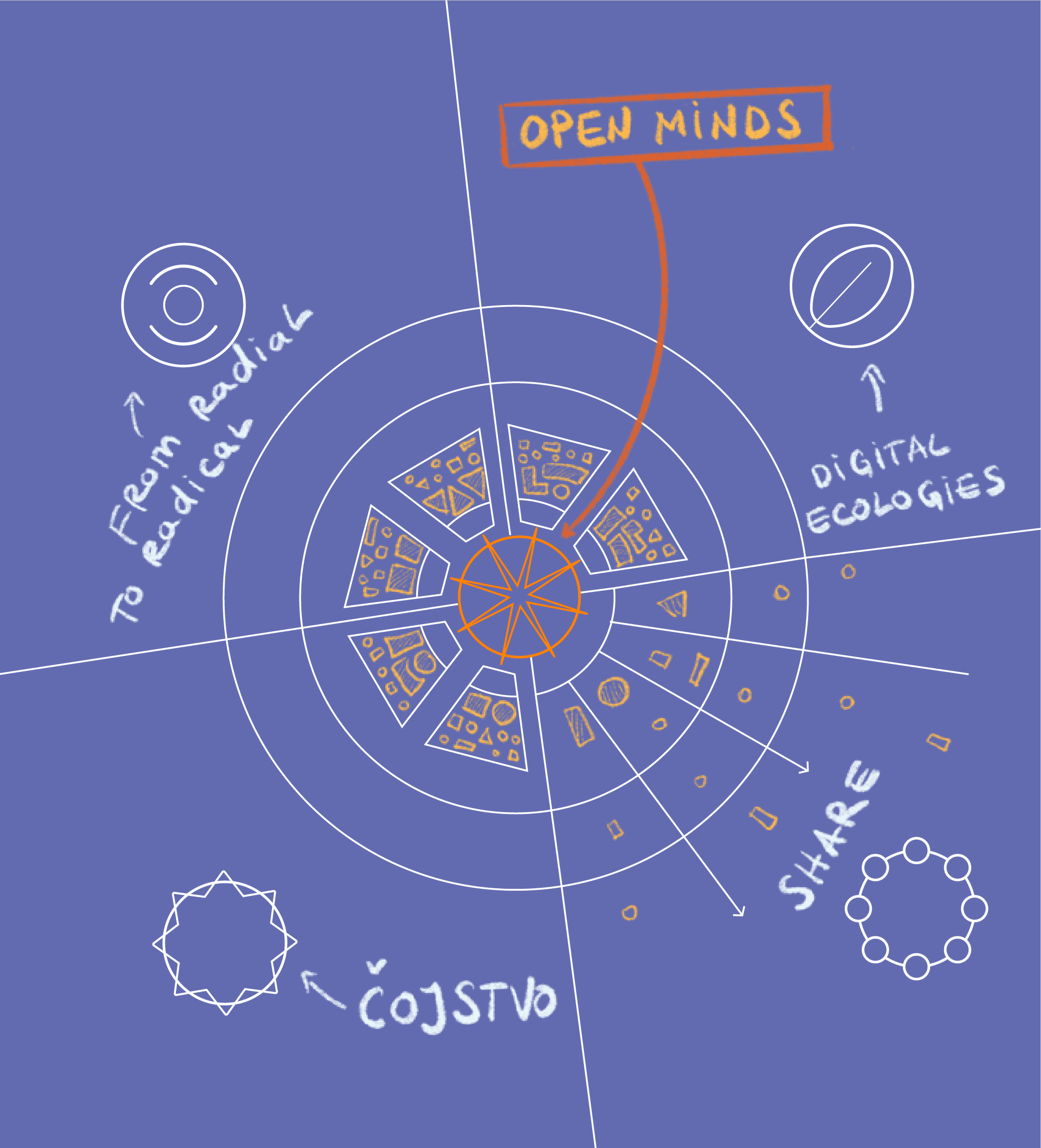
 Open Minds: Open Minds is our capacity-building line, focusing on knowledge-sharing, and professional development. It also supports personal growth and skills development that prepare citizens to embrace diversity. It has two clusters: Open to learn and Learn to open, and a flaghship – 3+1=O.P.E.N.
 Čojstvo (Being Human): Čojstvo is our authentic expression of humanism, which we place as the essential foundation of openness. This programme line focuses on projects that connect our local stories and heritage with European ideals and shared values. It has two clusters – Roots and Place of Stories, and a flagship – Moba: Documenting Čojstvo.
 Radial to Radical: Radial to Radical reflects on the dynamic relationship between the city (polis) and its people (demos). It creates a framework for empowering communities, improving individual well-being, and rethinking the role of public space. It has two clusters – Commune and Corso and a flagship – Radial to Radical.
 Digital Ecologies: Addressing a reality increasingly shaped by algorithms and climate breakdown, Digital Ecologies engages critically with the defining challenges of our time. It seeks ways to restore balance in a world often reduced to binaries, while positioning the city, in its post-industrial transformation, as a place where creative and digital industries can thrive. It has two clusters: R:evolution and Eco:nnect, and a flagship – Submerged Cultural Landscapes.
 Share: Rooted in the principle of solidarity, Share is an open programme line – it extends beyond dualities and rivalry, aiming to reimagine the very ECOC competition process — shifting it from a contest into a platform for collaboration and co-creation.